
Years ago, before my first trip to Las Vegas, I did what any young chemical engineer would do. Homework! Before I committed cash, it only made sense to know the house odds on every game in the casino. My essential reference was The Full Time Gambler, by Louis Holloway, who originally published the book in 1969 and had bought a house and paid for his son’s college tuition by winning more often than losing. I was in college when I read the book. It seemed to me that Holloway would know.
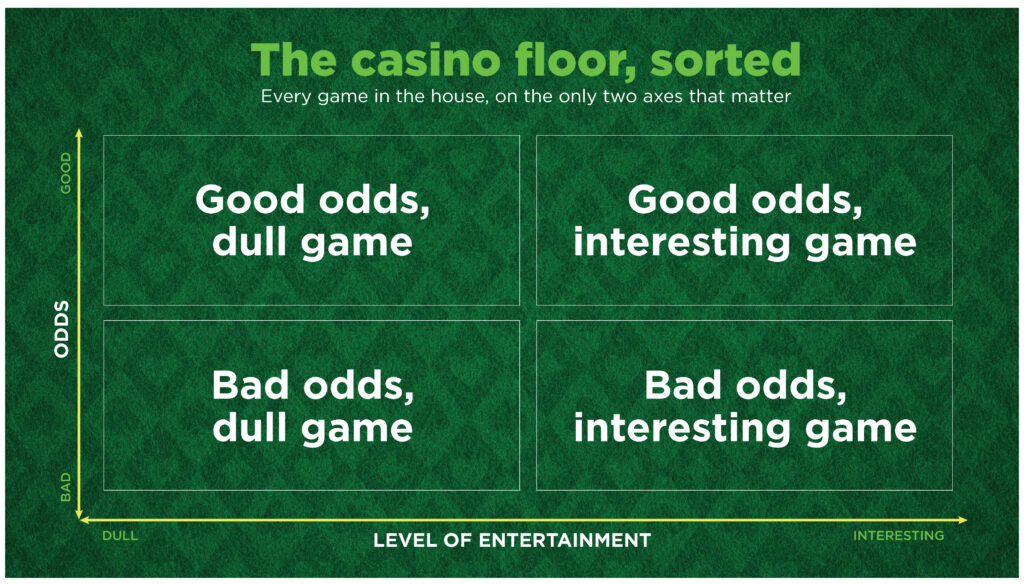
So I dutifully sorted all the Vegas games into a two-by-two matrix. The quadrants were (1) good odds but dull, (2) bad odds and dull, (3) bad odds but interesting and, the purely theoretical, (4) good odds and interesting. Yes, I took a matrix to Sin City. Some people go there to lose their inhibitions. I went to run a decision model.
My initial analysis said to play blackjack just because it had the least bad odds in Vegas. Theoretically, the house and player stand at almost even odds. Perhaps I’d be clever enough to do some card counting? But alas, the lesson I learned had less to do with odds and more to do with an unavoidable lurking variable. Time! To actually win, the pros camp out for days waiting for all the variables to line up. I had a weekend and $20 of working capital. The tables were $3 minimum. If I had a cold spell and lost six hands in a row, which is statistically quite plausible, I’d be headed for the door.
Roulette, however, had potential. Worse odds, true. I knew that. But in those days, you could play for 10 cents a chip, which means I could buy time. I wasn’t there to beat the house. I was there to rent a chair at the lowest rate in Nevada. Fair enough, with the understanding that the house had run the numbers before I did. The rule was you still had to have 10 chips on the table for each spin. Good bets ran $3 a hand and bad ones ran $1. Fine. Game on.
If you’ve only ever seen roulette in James Bond movies, here’s what you should know. An American wheel has 38 spots for the ball to drop into, and it pays winners as if it had 36. You can even bet on the two green zeros. It’s all spelled out, right there on the felt, which makes roulette a bad bet with full disclosure. You have to admire the candor. The house maintains a 5.26% edge, every spin, all the time. You can’t beat it. You just pace yourself on how slowly you’d like to lose.
As a matter of practice, if a casino hears about a gambler with a lot of money and a claim to a “system” for roulette, the casino will fly the gambler to Vegas and put them up in one of their suites. If you’re wondering why, I am so sorry. Whether an evening of roulette constitutes entertainment or arithmetic will-to-believe depends entirely on the player.
These days, the dime tables are long gone, but the homework habits and odds calculations are as strong as ever. Right now, I’m reading Nassim Taleb, whose bestseller The Black Swan is basically a catalog of smart people misreading odds. In it, he tells the story of a coin flip that comes up heads 99 times in a row. Wow! What are the odds? Can you predict the 100th flip? The statistician says 50-50 because, after all, past flips don’t change the next one. But the wiseguy from every mob movie ever says (read this with your best Brooklyn accent), “Yeah right, that’s a fixed coin.” The stats guru knows math. The wiseguy correctly calls the toss in advance.
Taleb also discusses a big Las Vegas casino cataloging its worst losses. The casinos have experts who have created a sophisticated gaming system that ensures great returns with caps in place so they don’t get crushed by a rogue bit of bad luck. The house always wins, though the big losses don’t come from the tables. There are different sources of rogue bad luck in the blind spots. It’s the tiger that mauled the trainer. It’s an employee who sat on years of unfiled tax forms. Casino games represent risks the house has already priced. The most devastating losses experienced by the casinos actually came from outside the math.
I’d like to say people wise up to bad bets. But … no. Truly dumb bets survive contact with adulthood. They just acquire steering committees and sometimes consulting firms to pre-ratify a big decision.
Take the airlines. Please! After deregulation in the late 1970s, half the industry made the same bet all at once thinking that market share was the prize. Thus, fare wars. That’s how you’d win. Fly more routes, cut fares deeper, out-bleed the competition. It had every tell of a really dumb bet, including the three most dangerous ones, which are (a) MBAs with calculators and colorful presentations, (b) a business case (complete with sexy project name) and (c) a competitor doing it too. That’s how dumb bets pass for strategy. That’s why a lot of big airline names from that era are now vintage luggage tags. Meanwhile, the quiet operators (well, at least one) bet on boring things such as cost per seat-mile, fast turnarounds and standardized planes. They ended up owning the sky.
And in baseball, the Oakland A’s found an undervalued statistic and won with it. Then for the next decade, everyone bought the same stat at higher and higher prices, called it strategy but neglected fundamentals. A really dumb bet is rarely a dumb idea. It’s often a good idea, latched onto late. Swing and a miss.
Which tells you what a good bet actually is. It’s more than good odds. It’s more likely a mispriced edge, held long enough for skill to separate from luck. One roll of the dice proves nothing, and one game of baseball proves less. But a 162-game MLB season is the ultimate anti-roulette. By mid-September, the standings tell the tale. Here’s an important caution, though. Every edge has a shelf life. Once latecomers pile in, the mispricing is gone, and yesterday’s good bet is today’s really dumb one.
Spin back with me to the dime table. Roulette was entertaining, no doubt. But after a while, I made like Kenny Rogers and walked away — and not because I was losing too many dimes. I quit because I’d solved the only puzzle the room offered, which is knowing when to leave. Game over.
With that, I cashed out the chips and kept the lesson. It’s a lesson that’s traveled with me ever since. The games with posted odds are the small ones. The bets that mattered came later and mattered more. Nobody prints the odds for big bets on the felt. But you have to play anyway.