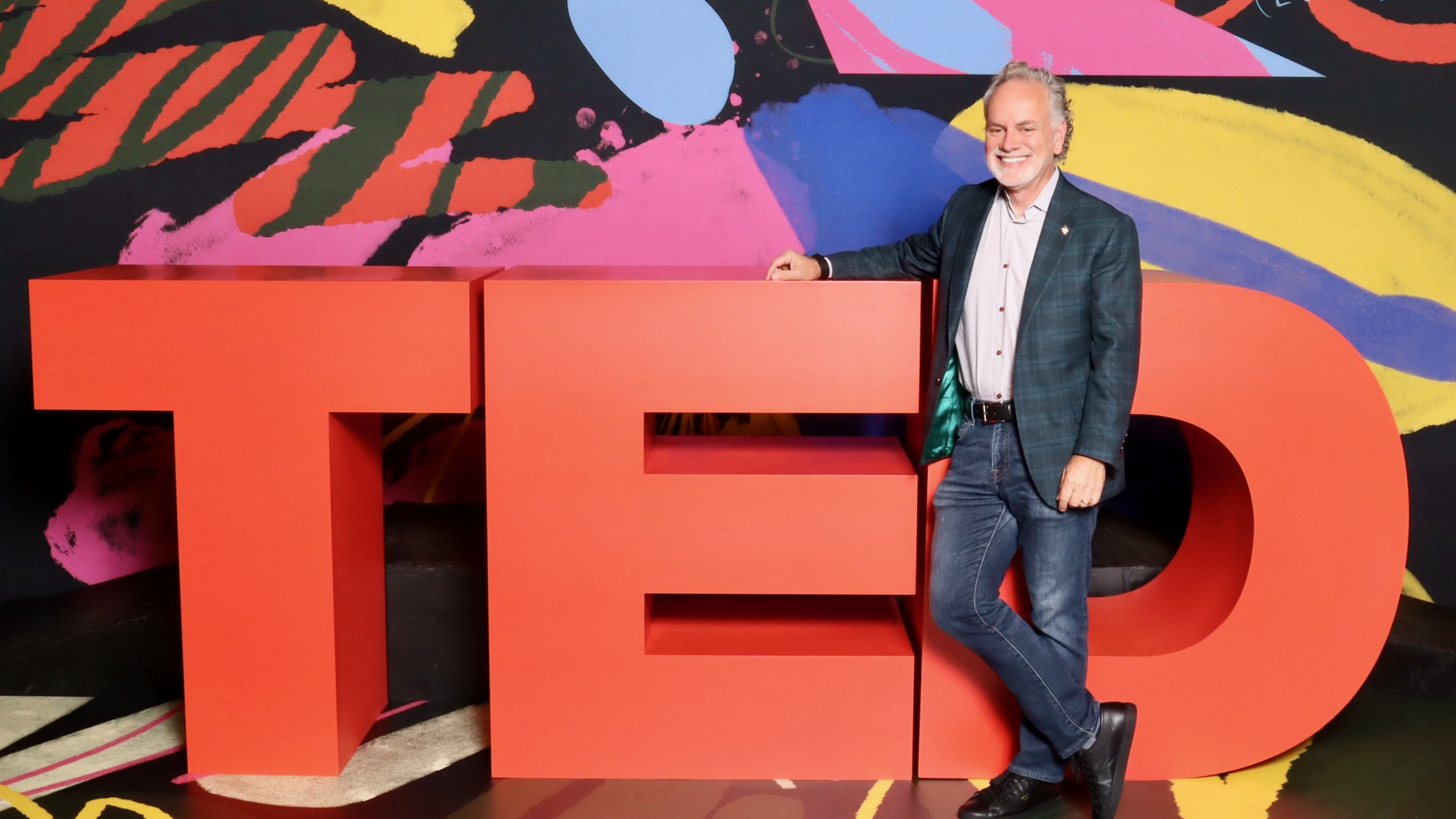
I went to TED expecting Technology, Entertainment and Design. I got something else.
The T appealed to me right away. I’ve always been a science enthusiast, and I began my career as a degreed chemical engineer. Besides, I like knowing how things work. The E part was a gimme because I enjoy a good show, concert or comedian. D is for design, and yes, that made me nervous because I am the guy who shows up in a jacket when everyone else is in sweats and sneakers. But that’s OK. A good supply chain is well-designed, right? Fine. Three for three.
What I didn’t expect was H.
H wasn’t on the marquee. But H for Humanity was the through-line.
TED’s own invitation this year opened with this line: “The future has never felt more volatile. Politically, technologically and culturally, the rules are being rewritten.” So that was the vibe going in, but what I found is deep and substantial talk on what it means to be human when everything else is up for grabs.
AI, of course, exerted an enormous gravitational pull. Every session had at least one AI talk, and a few sessions had nothing but. The range was extraordinary. One speaker shared that AI experts he’d surveyed put the odds of AI wiping us out in the next 20 years at greater than 10%. Another framed AI as the new oxygen — a development that could usher in a new era, the way oxygen did billions of years ago, and spawn a more adaptable humanity. A third discussed building a virtual cell that could speak the language of biology the way large language models speak ours. Heady stuff indeed, and not always rosy.
But the talks that made me lean forward weren’t about AI. The ones that hit home were about what humans do that machines don’t or can’t. The compelling nature of that fact was threaded through every presentation and under every argument.
Consider George Butler. Butler is a British reporter and artist who walks into war zones with pen, ink and paper. In 2012 he crossed from Turkey into Syria as a guest of the Free Syrian Army and drew the civil-war-damaged town of Azaz. A decade later he spent days in the Kharkiv metro sketching families sheltering underground during Russian bombardment. His talk was called “Why I Spend Hours Sketching in Conflict Zones,” and the answer is humanity. The process does take hours. He sits with one person and draws what he sees. His method is the opposite of social media binge blasts that reward speed, volume and reach. Butler works with presence, duration and direct awareness. Butler’s methodology isn’t about scaling at all. That’s the point.
Or consider Minal Hajratwala. Hajratwala runs Unicorn Authors Club, a coaching practice that helps leaders and dreamers write books. Her argument was that readers can still tell when a book was written by a human. She noted that there are people using AI to publish three AI-generated books a day, but there’s no there there. No best-seller buzz. No cultural conversation. No readers who come back for more. No doubt, AI can produce an infinite number of books. But Hajratwala stressed that readers look for something else.
And then there was James G. Robinson. Robinson is a director of data products at The New York Times and an adjunct at Columbia Journalism School. He’s spent the last several years writing and speaking about his son Nadav, who was born with a congenital heart defect. Sadly, Nadav died at the age of five. Robinson’s memoir is called More Than We Expected, and its message is that the son without the heart defect wouldn’t have been the son his father loved. Robinson’s TED talk connected with me deeply. I’m still thinking about it and know I will for years to come.
The three TED talks could not have been more different — visual reporting, book authorship and a family’s story. My takeaway is the thing readers, viewers and listeners find meaning in is simply a thing another human does that only a human can do. Quite profound, and very much in keeping with the theme of the 2026 TED conference, All of Us.
Even salmon made me reflect on shared humanity. Amy Cordalis Bowers, an attorney for the Yurok tribe in northern California, spoke about the removal of the dams on the Klamath River. Completed in 2024, it was the largest dam removal in U.S. history. Despite more than a century of blocked access, salmon returned to their ancestral spawning grounds. It’s mind-boggling to realize that generations of salmon who had never been within hundreds of miles of the uppermost Klamath feeder streams found their way back. Maybe it was in their DNA. Maybe it was the chemical signatures of the headwaters. But something called them home.
We as people have our own instincts. Though AI is flooding streams of discourse and even creating barriers, humankind has its own signature. We recognize it, respond and keep coming back.
H may not have been on the marquee at TED, but it’s what I brought home.
H FTW.