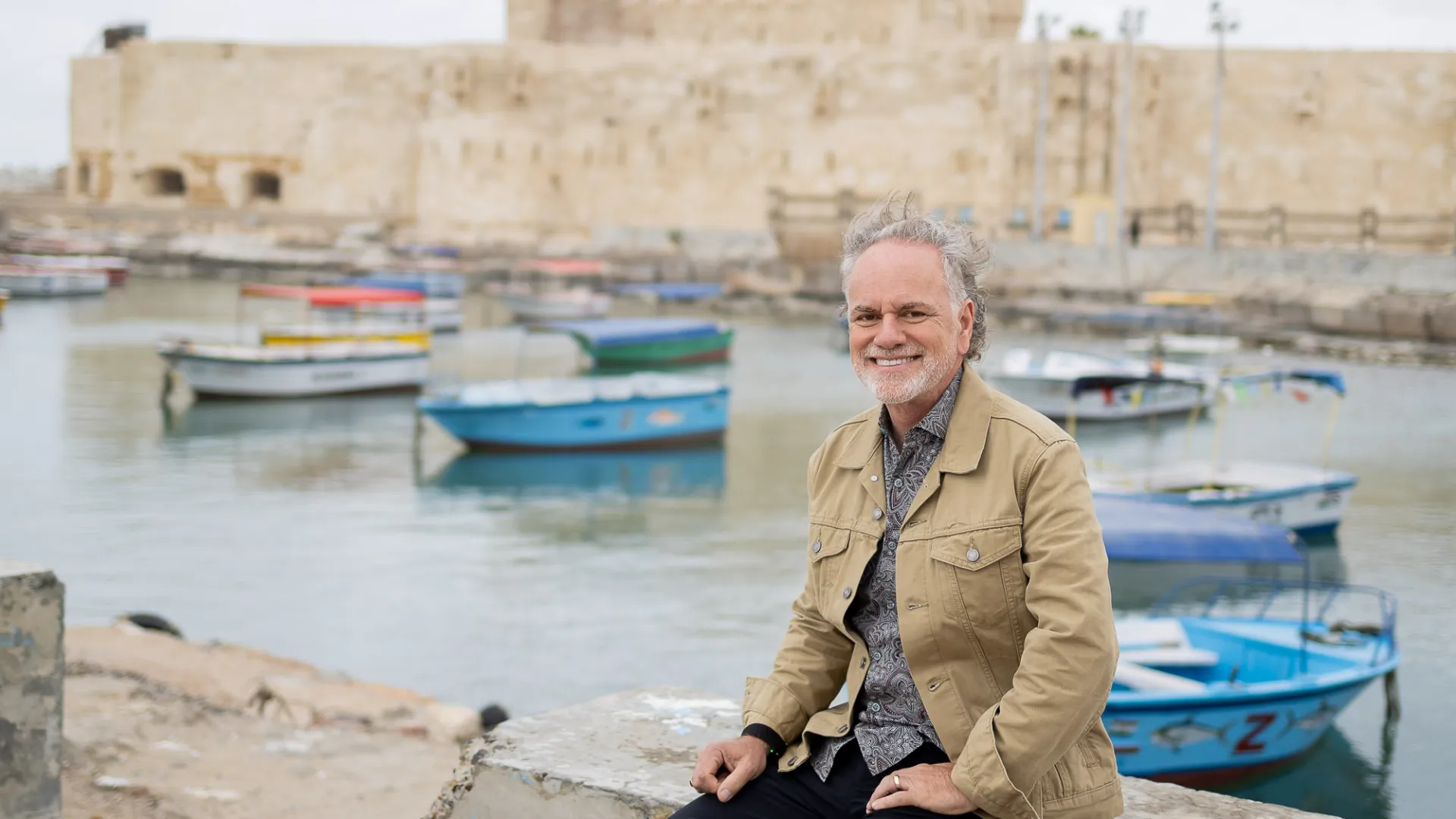
The walk out into the harbor at Alexandria is a stone causeway. It’s about a mile, if you do the whole thing. At the end of it, 14 centuries ago, stood one of the seven wonders of the ancient world, the Pharos lighthouse of Egypt. At 400 feet high, ships could see it 40 miles out at sea.
It isn’t there now. Earthquakes and time have taken it down. A medieval citadel was built on the foundations, and that’s what you see if you visit this Mediterranean port city. I was there with my family in March and walked the causeway trying to take in the full view. I came back with more than I went looking for.
Twenty-three Sarsam family members traveled together. Kids, a couple new spouses, sisters, nieces, nephews. We had a window of time to do this, and we went, changing a few plans before and during the trip. Our travels took us across the top of North Africa, from Cairo and the pyramids to Alexandria and finally Carthage.
I expected the pyramids to be the standout. They were all of that, literally. But Alexandria caught hold of my imagination in an instant. What I saw there is still in my mind’s eye, giving me pause to reflect on what’s being revealed in my own life.
Most Americans couldn’t place Alexandria on a map, possibly even Egypt as a whole. Maybe they know about the ancient library in Alexandria, the one Cleopatra no doubt had lending privileges at. After all, she was the queen there, and the library held what the ancient world thought of as all of human knowledge. But fires and time eventually wrecked the library. The Pharos lighthouse fell too. Of the two wonders of the ancient world in Egypt, in the present day only the Great Pyramid is standing.
Alexandria today is a city of about three million people sitting on the edge of the Mediterranean. Greek, Roman, Coptic, Jewish, Arab, Ottoman, modern Egyptian — every civilization that grew and flourished in the Mediterranean pulled into the harbor of Alexandria at some point. Many of them left something. Some of those things are buried. Some are underwater. Some have been rebuilt as something else.
The new Library of Alexandria, which opened in 2002 a short walk from where the original stood, echoes the past and is magnificent in its own right. Its presence, though, is a reminder of what was there before.
That’s the thing about Egypt. It’s a 5,000-year-old live-time demo that the visible surface of things is the least reliable witness to what’s actually under your feet. Most of what we now call ancient Egypt was buried in sand for more than 1,000 years. The Sphinx was buried up to his chin. The Great Pyramid was two-thirds buried in sand too. Karnak — fifty feet of carved stone, the largest religious complex ever built — was buried almost to its roof. Then, in the 19th century, people started digging, and past splendor and mystery emerged.
It makes you wonder … what else is down there? After all, most of what tourists now photograph at Giza and Luxor wasn’t visible to anyone for 14 centuries.
What is visible is an altered version. All the temples, all the statues of Ramses, all the columns at Karnak — the ones we picture as bare stone — were originally painted. So was the Parthenon in Greece for that matter. The bare-stone version of antiquity we carry in our heads is what survived contact with sun and wind. The painted version, the loud version, the version people long ago saw, is preserved only inside the tombs in the Valley of the Kings, where the colors stayed bright because they were in the dark for 3,000 years.
So there’s old. And then there’s a lot older. Even Cleopatra would have thought the pyramids were old. She was born about 2,000 years ago, which makes her closer in time to the iPhone than to the pyramids in her own backyard, which were built about 2,500 years earlier. When she stood at Giza, what she saw was already ancient. She would have looked at those monuments and thought … that’s a long time ago. She was modern in her own story.
So is everyone who has ever stood there.
That’s what I keep thinking about. What we hold as history right now is not much different from what Cleopatra held as history when she saw the pyramids. It’s a small slice of a greater whole. The Eastern Roman Empire, which lasted 1,000 years after the Western one fell, barely shows up in what most of us were taught. The Coptic centuries, which ran continuously from St. Mark in the first century to the present day, get skipped. The trading routes across the Sahara and mountainous steppes to the east, connecting many ancient civilizations, are mere traces. Artifacts remain, with some lost and others living on in new form. Yet far more is buried in the sands and strata of the textbooks we learn from.
The visible past is a thin veneer. The actual past is much wider, mostly underneath and slowly being unburied by people who decide there’s something down there worth digging for.
Layers accumulate. Years, centuries and epochs flash by.
I am home in Phoenix now. The Sonoran Desert outside my window has its own layers and has risen up anew by many peoples who have called this enchanting place home. Most of my own kids came back to Phoenix and may raise kids of their own here. Woven in every great story are people, adding themselves to the fabric of a place already layered in a rich and vibrant tapestry going back countless generations.
Egypt was the oldest civilization on Earth by the 4th century BC. Then came Alexandria, a port city that took in the new world around it and gave so much back over the ensuing centuries. Now after another 2,000 years, Egypt continues to give more amazing gifts to the world.
I came home even more interested in things barely glimpsed and not fully revealed, both in Egypt and also in what comes next for me. Egypt tempts us to dream about what will yet be revealed. Alexandria asks us, what is yet to be built?
I am going to find out.