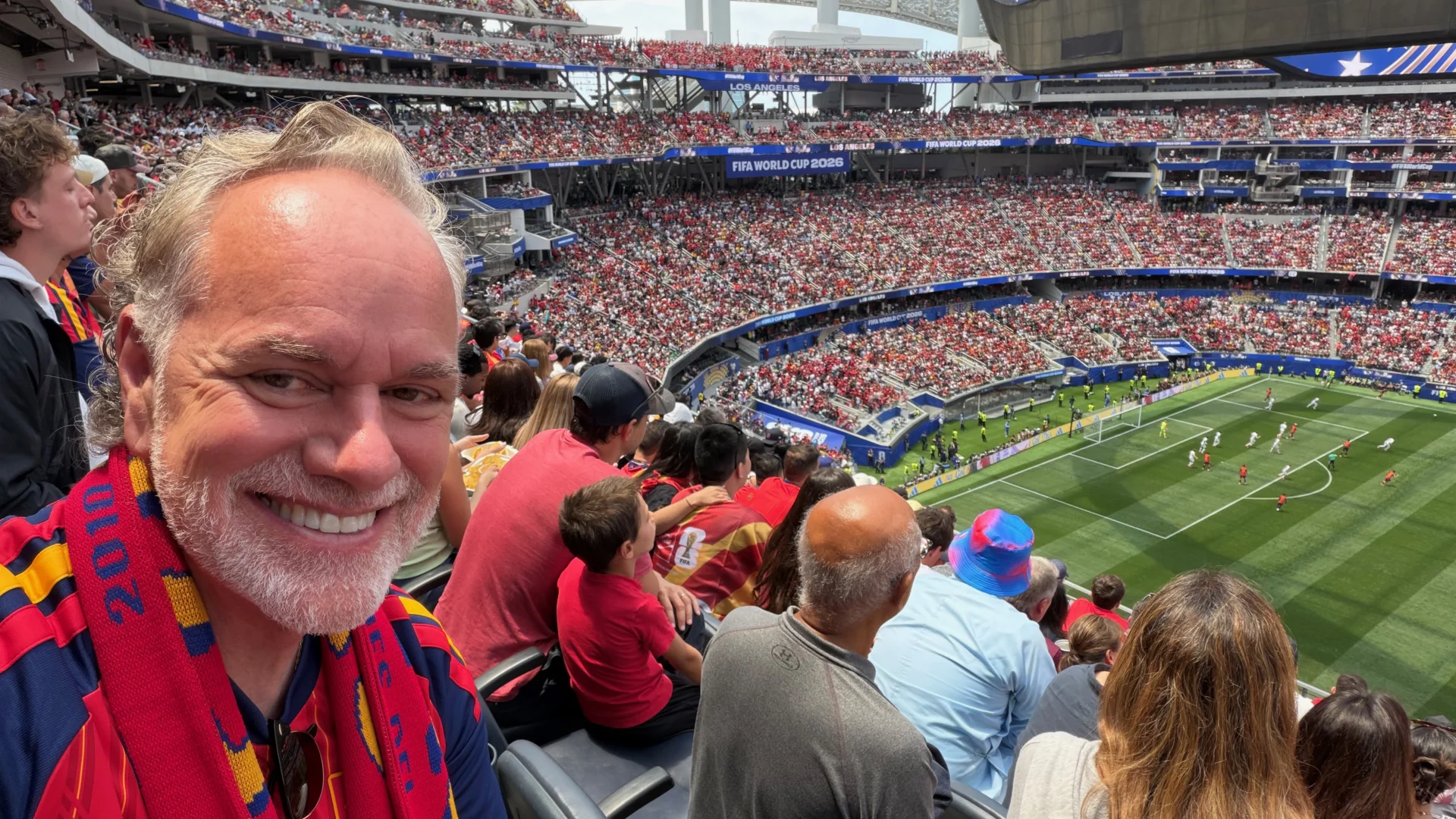
Last Thursday in Los Angeles, I was one of more than 70,000 people in a sold-out SoFi Stadium, watching Spain and Austria compete in the FIFA World Cup. Usually when I’m in L.A., I’m there to root, root, root for the home team. This time, I was there to cheer for the game itself, which has revealed that “home” and “away” don’t necessarily apply to fútbol or fußball. Yes, fans travel from their home countries to cheer for their own. But the thrilling part isn’t the traveling. It’s that the world is already here.
I’ve done enough traveling to know that some places keep their distance. There are corners of the world where practically no one will engage you at all unless they already know you personally, where a stranger stays a stranger by design. You get used to it. A hello there would surprise me.
So I’ve watched this summer’s World Cup with great interest. What would the millions of global soccer fans traveling to America expect? Would they expect us to keep our distance? Would they keep theirs? How would this global get-to-know-you go?
The more I watch, the more it seems to me that the world didn’t arrive here as strangers at all. The world was already here. Sometimes a visiting team would take the field and find the stands full of its own people, the faces and chants of home. Other times, locals showed up and said hello on their own terms. Rather than strangers in a strange land, the tournament has shown American culture at its best, a manifestation of the world’s expectation of what could be, after 250 years of work.
Each visitor came with their own paradigm, of course. These ideas of what they would find in America were (most often admittedly) significantly influenced by a media that has found that fear and angst sell better than warmth and kindness. It’s no surprise to me that our global guests found plenty of warmth and kindness in the communities that hosted them. Why? Because a pre-formed mental image and an actual place often turn out to be two different things. A country is a little like a person that way. You think you know someone by reputation. Then you meet them, and the reputation is never the whole story.
What they found was America unfiltered and 1:1. They discovered and showed us the things we live with every day … and maybe stopped seeing. It’s the way, as a psychologist told the BBC, that you stop noticing the wallpaper in your own home. Here, it’s not unusual for strangers to smile and even say hello. People might ask where you’re from and then wait for the answer. It’s the kind of howdy I stopped expecting abroad but often hear on American sidewalks.
There’s Lawrence, Kansas, of course. It’s a college town with no particular reason to know much about North Africa. Algeria made it their World Cup base camp, and Lawrence did more than say hello. The University of Kansas marching band learned the Algerian national anthem and played it at an open practice, the stands full of fans in green, white and red, as Kansas City’s KSHB reported. An artist built a giant Algerian flag out of earth on campus. And Algeria’s coach told ESPN the crowd waiting outside the team hotel that first night gave him goosebumps. What happened in Lawrence has happened in many other places across the U.S.
Scotland’s fans had waited 28 years to get back to a World Cup, and tens of thousands of them crossed the Atlantic and took over Boston, spreading out to nearby New England. Before they left, the Boston Globe reported, they handed nearly $30,000 to charities in nearby Providence, a check for a children’s cancer ward, money to get kids into the game. So the welcome ran both ways. By the end, Boston and Glasgow had agreed to become sister cities.
And here’s the part that stays with me. What the visitors found, over and over, was a reflection of themselves. We are people from their own communities, separated only by time and distance. The fan in the next seat could easily have a grandmother from the same town. The American experiment was the world’s experiment … people came here from countless villages and built this fine country. The best of America belongs to the entire world.
Yes, America is not without its faults. No country is. The world that gave so much to American culture is far from perfect either. We have never been afraid to put our flaws on display and argue them in front of the entire world. Alexis de Tocqueville visited America nearly 200 years ago. To paraphrase one of his remarks, “The greatness of America lies not in being more enlightened than any other nation, but rather in her ability to repair her faults.”
I might put forth another element of our greatness lies yet in another de Tocqueville finding. When traveling through the more distant parts of the new nation, he marveled at how hospitable both wealthy planters and modest log cabin owners were to weary travelers. He frequently relied on this “backwoods” hospitality, where hosts would “bid me sit down beside his fire.”
This FIFA World Cup mirrors who we are when we’re at our best. I’ve always felt that America is an expression of the world’s highest hopes, given the grand amalgamation that made the place historically and continues reshaping it today.
Global visitors brought themselves, and we’re different and better for it. The lines blurred, the way they do when people share a place and time long enough. And somewhere in all of it, between the anthems and hellos, the ranch dip and Waffle Houses, the free refills and brisket at Buc-ee’s and the long way everyone traveled to get here, our visitors became something more than guests. They became us. They’re Americans. We, in turn, re-introduced ourselves to the world.